
Iron County Court Records Path
Iron County court records after a jail arrest should be read as a sequence, not as one single database entry. The Iron County Correctional Facility handles booking, custody, housing, and release status for people held by the sheriff. The arresting agency submits a report. The Iron County Prosecuting Attorney's Office reviews that report and decides whether to authorize charges. Once a complaint or other charging paper is filed, the court case becomes the public record for the prosecution if the case is not sealed or otherwise restricted.
That distinction matters. The jail may know whether a person is in custody before a public court case appears. Booking charges can also differ from the court charges later filed by the prosecutor. Use Iron County jail inmate records for custody and booking status. Use Iron County jail roster mugshots for booking-photo and mugshot questions. Use the court record for the formal charge list, court events, bond orders, pleas, dispositions, and sentence entries that follow an Iron County arrest, and use the Iron County Clerk/Register page for county records and court-adjacent routing.
The county sheriff page lists Sheriff Ryan Boehmke and the Iron County Correctional Facility phone line. That local custody channel is useful when an arrest is recent, when MiCOURT has not yet updated, or when the issue is a hold rather than a new criminal case. After filing, the court record is the stronger source for the charge itself.
Iron County Court Records Search
The statewide public case-search channel for Iron County court records after an arrest is MiCOURT Case Search. MiCOURT is not a jail roster. It is used for public court cases, including criminal charges after filing, case numbers, future hearings, register-of-actions entries, bond terms, dispositions, and warrant events that appear in the court file. If an arrest happened late at night, on a weekend, or before prosecutor authorization, the Iron County Correctional Facility may have custody facts before MiCOURT shows a public case.
The MiCOURT Case Search portal is the source shown here for court-case lookup after an Iron County arrest.
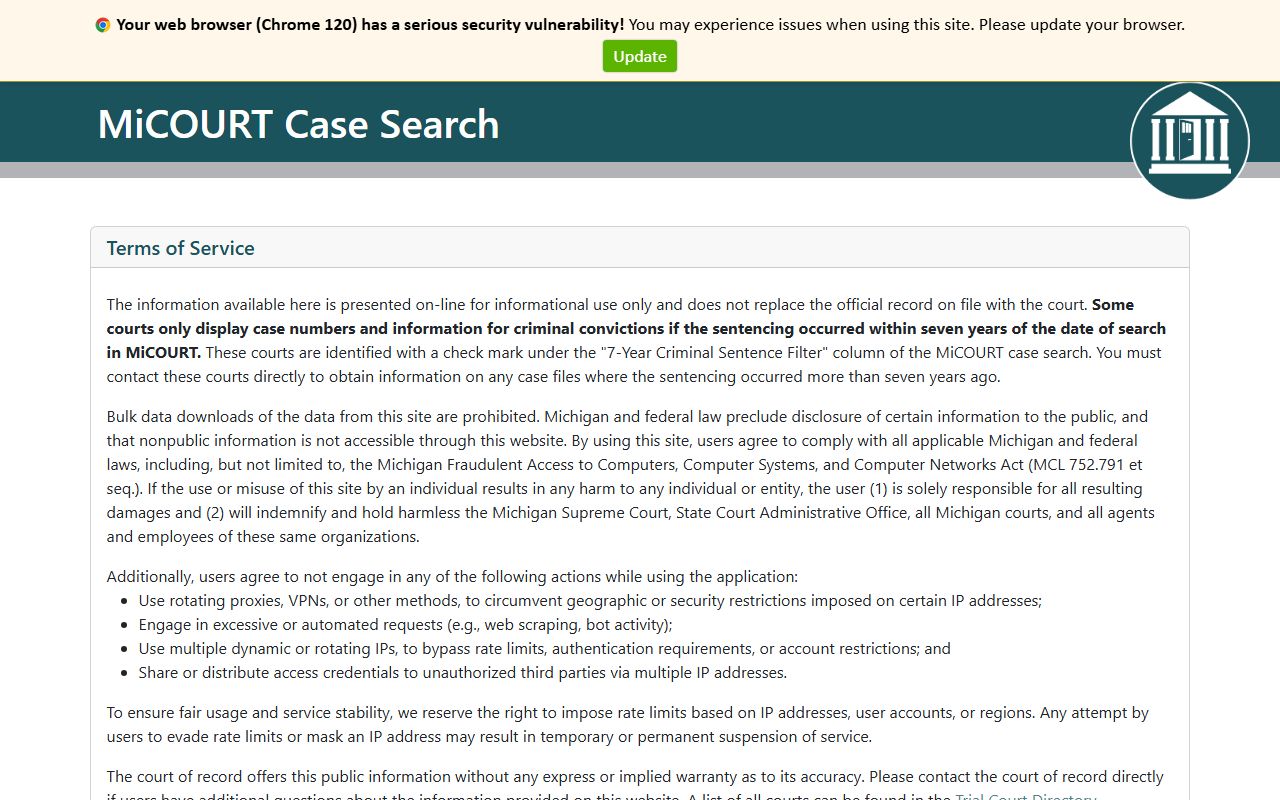
Use the court and criminal-case filters before treating a result as tied to the arrest, because name-only searches can return unrelated cases.
| MiCOURT Field | Type | Required | How It Helps |
|---|---|---|---|
| Court or court location | Dropdown or search selection | Usually needed to narrow | Select the Iron County court or the relevant jurisdiction when the interface offers it. |
| Case type or category | Dropdown or filter | Depends on search path | Choose criminal when the goal is court records after a jail arrest. |
| Party name | Text | Conditional | Search by defendant name. Exact spelling helps with common last names. |
| Case number | Text | Conditional | Use a number from a complaint, notice, citation, court paper, or jail contact. |
| Date of birth | Date or text | Optional where shown | Helps separate people with similar names if MiCOURT exposes the field. |
| Search and reset | Buttons | Not applicable | Run the lookup or clear filters before starting a new Iron County case search. |
- Confirm the arrest and custody status with the Iron County Correctional Facility when the arrest is recent.
- Ask for the arresting agency, arrest date, and any case, citation, or warrant number known to the jail.
- Search MiCOURT by defendant name or case number, then narrow to Iron County or the relevant trial court path.
- Open the case and compare the court charges against the original booking charges.
- Check each charge for statute, level, status, bond, hearing date, plea, disposition, and sentence entries.
Iron County Arrest Charging
Michigan counties use a Prosecuting Attorney, not a District Attorney. In Iron County, the prosecuting attorney reviews police reports and authorizes adult felony and misdemeanor charges. The official county page identifies Prosecuting Attorney Chad A. DeRouin and states that the office reviews and authorizes charges, appears in criminal cases on behalf of the State of Michigan, and provides victim-rights services. That role sits between jail booking and the court docket.
The Iron County Prosecuting Attorney page is the local source for charge-filing context, office contact details, and victim-rights routing.

For case lookup, the prosecutor page explains who authorizes the charge, while MiCOURT shows the public case after filing.
A prosecutor may authorize the same charge listed at booking, decline a charge, add a charge, amend a charge, or file a different level of offense. That is why an Iron County court record after an arrest can look different from the early jail intake note. The court charge controls the prosecution. The jail entry explains custody.
Iron County Charging Documents
The first public court record after an Iron County jail arrest often depends on the charging document. A complaint is common at the start of a district-court criminal case. An information is a prosecutor-filed felony charging paper used after preliminary proceedings or waiver. An indictment is a grand-jury charging document and is not the usual route for most county cases. The document tells the court what offense is being prosecuted, but later court events may change the charge list.
| Document | Filed By | Common Use | Effect on the Case |
|---|---|---|---|
| Complaint | Prosecutor, often based on police reports | Many district-court criminal starts | Begins the formal case and states the alleged offense. |
| Information | Prosecutor | Many felony prosecutions after preliminary steps | Sets out the felony charge to be tried or resolved in circuit court. |
| Indictment | Grand jury | Serious or less routine felony matters | Creates a charge through grand-jury action rather than the routine complaint path. |
These terms do not mean guilt. They describe how the accusation reaches court. A person may have an arrest, a booking entry, and a court charge, yet still have no conviction. The outcome depends on later hearings, plea, trial, dismissal, or other disposition.
Iron County Charge Status
Charge status is one of the most useful parts of Iron County court records after a jail arrest. The status explains whether the accusation is still active, changed, dismissed, or resolved. It also helps show why a jail roster and a court case may not match. A booking charge can be an early law-enforcement label. A filed charge is a prosecutor-approved court allegation. A final disposition is the court's recorded outcome.
| Status | What It Means | What to Check Next |
|---|---|---|
| Pending | The charge is still open and no final disposition appears. | Review future hearings, bond terms, attorney entries, and court dates. |
| Amended or reduced | The filed charge changed, often through prosecutor action, plea negotiation, or court order. | Compare the original count to the active count and final plea count. |
| Dismissed | The charge was dropped by court order or prosecution action and is no longer being pursued in that case. | Check whether other counts remain pending or resolved. |
| Nolle prosequi | The prosecutor has chosen not to proceed on that charge. | Look for whether the dismissal is tied to another charge, case, or agreement. |
| Convicted or pled | The case reached a guilty verdict or plea on that count. | Read the sentence, fines, costs, probation, jail credit, and set-aside eligibility later. |
Iron County Bond Records
Bond is tied to the court case, even when the first practical question is whether the Iron County Correctional Facility will release the person. After an arrest, the jail can often say whether bond has been set, what type appears in its custody system, and whether a hold blocks release. The judge or court controls the bond order. If MiCOURT shows a different bond term than a jail phone call, confirm before paying or traveling.
| Bond Type | How It Works | Iron County Checkpoint |
|---|---|---|
| Personal recognizance | Release is based on a promise to appear, often with written conditions. | Ask whether any no-contact, travel, testing, or reporting terms apply. |
| Cash bond | A set amount must be paid as ordered by the court. | Confirm the amount and payment location before going to the jail or court. |
| Surety bond | A licensed surety or bail agent may post the bond if allowed. | Confirm that surety bond is accepted for that case and no hold remains. |
| Conditional bond | Release is allowed only if the defendant follows listed terms. | Read the court record for no-contact, alcohol, drug, weapon, or travel limits. |
| No-bond hold | Release is not available until a judge changes the order or a hold resolves. | Ask whether the hold is local, another county, state supervision, federal, or immigration related. |
No Iron County-specific online bond payment page or bond fee schedule was located in the research. The documented workflow is to call the correctional facility at 906-875-0651, ask whether bond has been set, ask where payment is accepted, and confirm the method before travel. A paid bond may not produce release if a bench warrant, probation or parole detainer, another county warrant, federal hold, or immigration detainer remains active.
Iron County Warrant Records
No official Iron County Sheriff's Office public active-warrant search, warrant list, or most-wanted database was located in the county sources reviewed. That absence matters because a person should not rely on a missing online list as proof that no warrant exists. Warrant-related court records after an arrest may appear in MiCOURT through bench-warrant entries, failure-to-appear events, bond forfeitures, or warrant recalls.
An arrest warrant authorizes custody based on an alleged offense or complaint. A bench warrant is issued by a judge, often after a missed court date or violation of a court order. A search warrant concerns a place or property and is not an inmate lookup tool. A fugitive warrant or hold may mean another jurisdiction wants the person. If law enforcement arrests someone on any of these, the person may be booked into the Iron County Correctional Facility until bond, court appearance, transfer, or release.
Use direct channels for warrant uncertainty. Search MiCOURT for public case events. Contact the court clerk if the case is unclear or older records are not online. Use MDOC OTIS for parole or probation absconder status when state supervision is involved. Federal warrants are handled through federal court or the U.S. Marshals, not the BOP inmate locator.
Iron County Charges vs Convictions
A charge is not a conviction. Iron County court records after a jail arrest may show allegations before any plea or finding. The difference is important for employers, landlords, family members, and the defendant. A charge can be pending, amended, reduced, or dismissed. A conviction follows a guilty plea, no-contest plea where accepted, or verdict and is recorded as the court's outcome.
| Point of Comparison | Charge | Conviction |
|---|---|---|
| Stage | Accusation filed in court after prosecutor authorization. | Final outcome based on plea or verdict. |
| Proof level | Based on probable cause or charging review. | Requires proof beyond a reasonable doubt or a valid plea. |
| Record meaning | Shows what was alleged and how the case moved. | Shows legal responsibility and sentence terms. |
| Can it change? | Yes. Counts can be added, reduced, amended, or dismissed. | Yes, but only through appeal, court order, set-aside, or other post-judgment process. |
Iron County Record Access
Michigan FOIA applies to public bodies and gives people a route to inspect, copy, or receive public records unless an exemption applies. For Iron County arrest and jail materials, the right source depends on the record. Custody questions go to the Iron County Correctional Facility. Arrest reports, booking records, and mugshot requests may route through the sheriff or the Iron County FOIA process. Court charges and case events are court records and should be searched in MiCOURT or requested through the court clerk.
State law does not make every detail public online. MCL 15.231 states Michigan's public policy favoring access to government affairs and official acts. MCL 15.233 gives the right to inspect or receive copies of public records, subject to the act. MCL 15.234 governs fees such as labor, copying, mailing, and deposits in proper cases. Active investigations, private personal data, medical information, juvenile records, sealed records, security-sensitive jail details, and set-aside records may be withheld or redacted.
The Iron County FOIA page is the county route shown here for requesting non-exempt public records that are not already online.

A FOIA request should name the person, arrest date, incident number if known, and the exact record type, such as booking record, incident report, or booking photograph.
Iron County Sealed vs Expunged
Michigan set-aside law can affect what the public sees after a criminal case is resolved. MCL 780.621 governs when eligible convictions may be set aside. MCL 780.621g covers automatic set-aside for certain eligible records after statutory conditions are met. These laws do not mean every Iron County arrest, charge, mugshot, or third-party copy disappears. They affect eligible official records under Michigan rules.
| Point of Comparison | Sealed or Suppressed | Set Aside or Expunged |
|---|---|---|
| Public visibility | Public access is limited or blocked by law or court order. | Eligible conviction records may be treated as set aside under Michigan law. |
| Who may still see it | Courts, law enforcement, or authorized users may retain limited access. | Access can remain for certain justice or statutory purposes. |
| Common trigger | Juvenile status, sealed filing, suppressed material, or protected case category. | Eligibility under Michigan clean-slate or set-aside statutes. |
| Practical limit | A sealed court file does not always erase jail or agency records. | A set-aside does not automatically control every private copy or old public scrape. |
Iron County Criminal History
Michigan State Police criminal history information is separate from Iron County jail custody and separate from MiCOURT case browsing. The Michigan State Police criminal history record information channel can be used for state criminal-history searches such as ICHAT where the state requires formal search terms or fees. That route is not a live jail roster and is not the same as a court docket.
For a current Iron County arrest, start with the jail for custody, then MiCOURT for charges after filing. For a broader criminal-history search, use the MSP channel and follow its terms. For sentenced state-prison status after a felony case, use MDOC OTIS. These systems answer different questions, and mixing them can lead to wrong conclusions.
Important: Public-record search results are not consumer reports under the FCRA and may not be used for credit, employment, tenant, insurance, or similar screening.
Restricted Iron County Records
Some Iron County court records after an arrest may be incomplete online even when the case exists. Juvenile matters, sealed charges, set-aside records, suppressed information, active investigations, security-sensitive jail details, medical information, and private identifying data may be withheld or redacted. A missing online entry can mean the case has not been filed, the search terms are wrong, the court path is different, or the record is not public.
When MiCOURT is unclear, use a narrow fallback path. Confirm current custody with the Iron County Correctional Facility. Ask whether there is a court date, case number, warrant number, or hold. Search again by case number if one is available. For non-exempt public records not shown online, use the county FOIA process or the court clerk route for court-held records.
Note: VINELink can support custody notifications where available, but it is not the official court record or jail record custodian.